A Study in Dust and Stone, Session 1: Scenario setup
Session 1 of the scenario "A study in Dust and Stone" for Call of Cthulhu 7th ed, where Lorenzo faces a mystery from his past.


In this log entry, I will perform the scenario setup rolls, as suggested in the Solo Investigator's Handbook by Paul Bimler.
The rolls I made fit very well with the background history of my main character, so I went all the way on the "family secret" route. We'll see where this leads.
Backup character is not present yet, how (if?) he will enter the story remains to be seen.
Well, what can I say. I'm already intrigued.
SCENARIO SETUP ROLLS
PROBLEM TABLE ROLL
[D100]: [100] => You are on a train, heading to your destination. The train leaves town and enters beautiful countryside. You drift off into a pleasant and peaceful sleep. Some hours later you awake to find the train empty and stopped on the track. You are the only passenger. Everyone, including the driver, is gone.
QUEST SOURCE TABLE ROLL
[D100]: [82] => An old family heirloom falls and breaks, revealing something mysterious inside.
CLUE TABLE ROLL
[D100]: [53] => A rune, made out in carefully placed stones on the ground
CHARACTERS INVOLVED OCCUPATION TABLE ROLL
[D100]: [96] => Historian
GENDER TABLE ROLL
[D100]: [70] => Male
NPC KEYWORD MODIFIER TABLE ROLL
[D100]: [41] => Brooding
URBAN LOCATION TABLE ROLL
I chose University
October 27th, 9:00 a.m.
On a train to Baton Rouge
The inciting incident arrived not by vision, but by post. A frantic, stain-rimmed letter from Mario Machini, the lifelong caretaker of Villa Bartolini, dated October 7th, 1925.
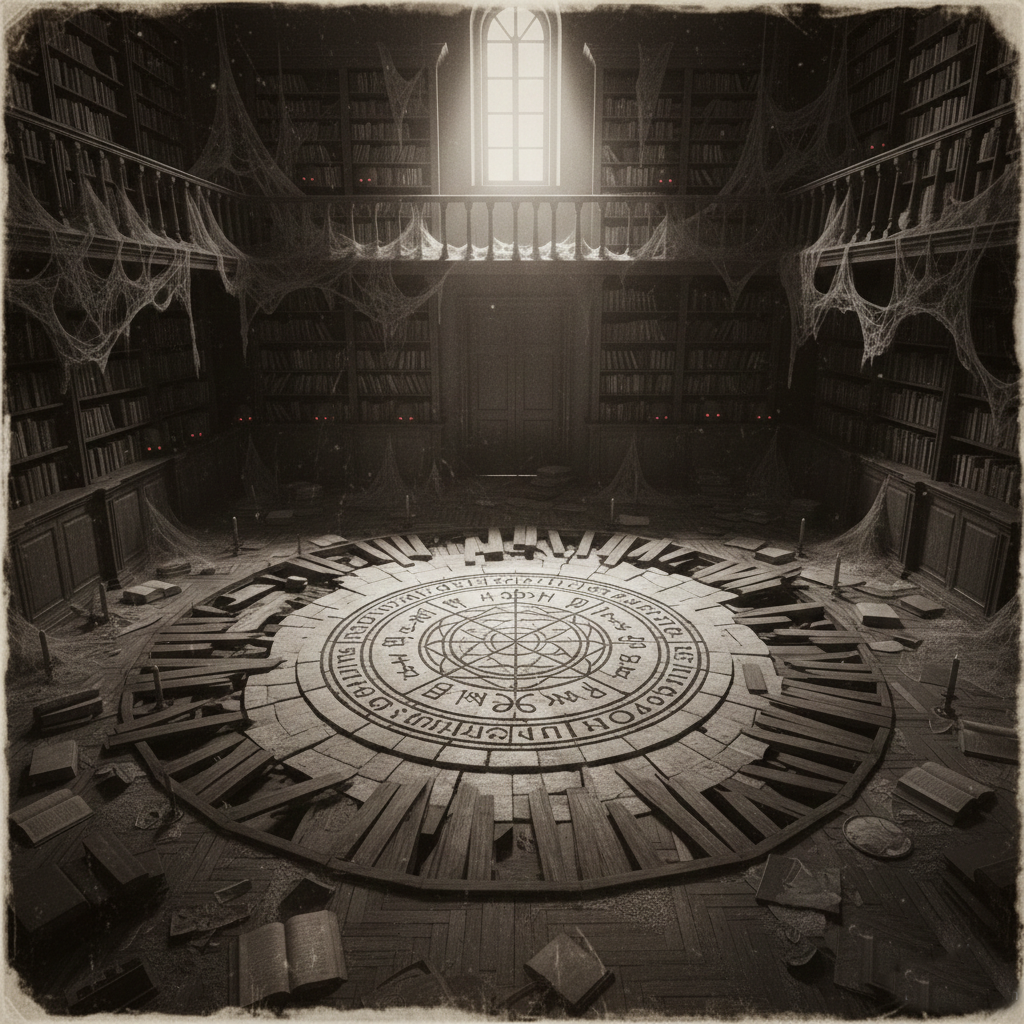
"Master Bartolini, the rains were unholy. They clawed through the roof of the library and rotted the very floorboards. When I pulled up the soaked planks to save the foundation, I found... it. A floor of cold stone beneath the wood, and upon it, a design made of set pebbles. I had our neighbor, Ms. Ravini, photograph it. Master, the sight of it curdles the milk in my stomach. I have covered it with a tarp, but I can still feel it through the soles of my shoes."
Included was the photograph: a jagged, morbid sigil. To my eye, it bore the unmistakable, twisted geometry of the Ars Goetia. But why was it under my father’s feet? Why was our history built upon a seal of the abyss?
I knew only one man with the cold temperament to analyze such a thing: Professor Sterling St. Claire of LSU. Our shared membership in the Dante Alighieri Society—a thin veneer for our true work in occult historiography—provided the necessary trust.
I boarded the morning train to Baton Rouge under a mocking, golden sun. The car was crowded—the smell of cheap tobacco, the rustle of newspapers, the low hum of travelers. I leaned my head against the cool glass, the rhythm of the tracks lulling me into a heavy, dreamless sleep.
I awoke to a silence that had physical weight.
The train has stopped. No steam whistles, no screeching brakes. Just the clicking of cooling metal. I stepped into the corridor, expecting the conductor’s irritation. Instead, I found a tomb.
The newspapers are still on the seats. A half-finished cup of coffee sits steaming on a tray. But the passengers—the dozens of souls who surrounded me only an hour ago—are gone. The engine is cold. The driver’s cabin is empty. I am a solitary passenger on a ghost train, stalled in the middle of a landscape that looks far too still to be Louisiana.